
Menu Close

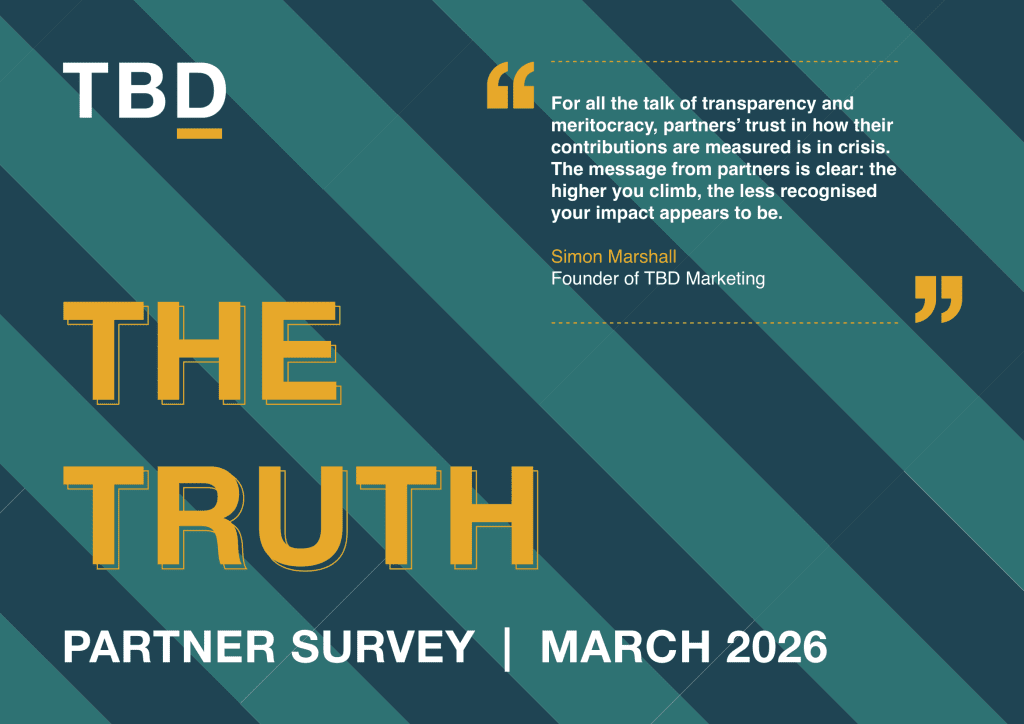
THE TRUTH

ABOUT LAW FIRM PARTNERSHIP

Partners still believe in their firms, but confidence weakens when it comes to how they are run.

We asked partners across the UK’s Top 250 firms to share their views on leadership, strategy and contribution.

This report sets out what they told us.

Following the success of our associates survey, we invited partners across the UK’s Top 250 law firms to share their views on their firm’s leadership, direction and priorities.

The results are in – and our respondents did not hold back.

At headline level, partners show strong underlying goodwill towards their firms. An overwhelming majority would recommend their firm as a place to work, and many have actively recommended roles to friends or colleagues.

Taken together, this suggests a cohort that remains invested in their firm’s success.

But beneath this positivity, the data reveals clear structural weaknesses.

Scores fall materially when partners are asked about execution rather than intent.

Client service consistency raises concerns, succession planning appears fragile, and perceptions of associate quality sit firmly in the middle ground — adequate rather than strong.

Most striking of all is contribution fairness.

While partners are broadly positive about leadership, culture and direction, far fewer believe their firms have found a credible way to measure, recognise and plan for contribution over the long term.

With one in five partners indicating they may exit their firm within the next three years, these weaknesses move from abstract concerns to immediate risks.

Simon Marshall | Founder | TBD Marketing

Key findings

The research points to a widening gap between what firms say they value and how partnerships actually function.

Boards and partners broadly agree on what matters: leadership, values, client stewardship and long-term growth.

Yet many firms struggle to translate those priorities into systems that feel fair, intelligible and durable.

It is within this gap that trust begins to erode.

of partners would recommend their firm as a place to work.
0 %
say partners should be rewarded for behaviours reflecting firmwide values.
0 %
of partners aren't sure they will stay at their firm for the next 3 years.
0 %
the average score for how fairly partner contribution is measured
0 /10

How the research was conducted

We approached the top 250 firms by headcount, and the partners in those firms directly, to provide a confidential forum to share their views — on their personal priorities and their partnership’s leadership and direction.

Data was gathered in such a way that we can ensure the source without identifying the owner, meaning each firm can be given its own verified scores. Initial responses were gathered from December 2025 to February 2026, and have been compared to our Associate Survey data, which launched at the end of 2025.

Our survey uses a range of measurements, including average scores and net promoter scores.

Net Promoter Score (NPS) is a widely used metric measuring loyalty and satisfaction, calculated by asking questions on a 0-10 scale. It categorises respondents into Promoters (9-10), Passives (7-8), and Detractors (0-6) to calculate a score ranging from -100 to +100.

Below zero signals that immediate improvement is necessary. A score of 0 to +30 shows room for improvement. A score of +30 and above is a strong, healthy and solid core with more loyal promoters than passive respondents.

How can I use this in my firm?

For leadership teams, the message is less about wholesale reinvention and more about closing the gaps. The findings are best read as an invitation to inquiry rather than a final verdict. Each firm will have its own story behind the numbers.

You can gain personalised results for your firm by running both the associate and partner surveys internally at a time that suits your firm best. Your results can be set against our independent industry-wide benchmark offering a clear and honest reflection of the mood within your organisation and the wider market.

Doing this will help:

  • improve board accountability
  • give data led insights for improvement
  • retain a happier and more committed workforce
  • pinpoint how your culture is defined, lived and breathed

Put simply, a personalised analysis will allow you to understand what motivates your partnership and employees, what frustrates them, and what they value most as a strategic necessity.

DOWNLOAD THE REPORT

A clear view of how partners across the UK see leadership, contribution and the future of partnership.